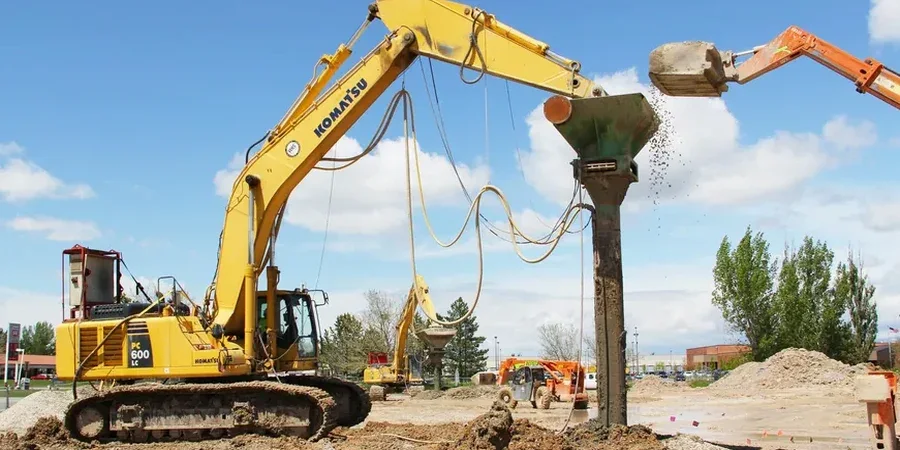
The National Building Code of Canada (NBCC 2020) and CSA A23.3 set strict performance criteria for foundation soils in high-seismicity zones, and North Vancouver sits squarely within one. Loose deltaic sands and uncontrolled fill — common across the Lower Lonsdale flats and the Capilano River corridor — require more than standard compaction if you are placing footings or mat foundations within 15 meters of grade. Vibrocompaction design, executed with an electric or hydraulic depth vibrator and real-time data acquisition, densifies these deposits to a target relative density that satisfies post-liquefaction settlement limits. When the liquefaction triggering analysis flags a factor of safety below 1.2 for the design earthquake, a vibro replacement or vibro compaction grid is often the most cost-effective remediation path before structural loads are applied.
Vibrocompaction converts a liquefiable sand lens into a dense, non-susceptible bearing stratum without excavation or imported aggregate — a critical advantage on constrained North Shore sites.
Regional considerations
The recurring mistake on North Vancouver infill sites is treating vibrocompaction as a commodity operation: ordering a rig, running a generic triangular grid, and skipping instrumented quality control. Without real-time monitoring — recording amperage draw, depth, and compaction time per lift — there is no proof that the design relative density was achieved below 5 meters. The consequence shows up during the geotechnical review for occupancy, when post-densification CPT soundings reveal untreated lenses and the owner faces a choice between re-densification or a costly redesign of the footings system. A proper vibrocompaction design includes a test section with at least three probe points, correlation of CPT tip resistance to Dr for the site-specific gradation, and a written acceptance protocol signed by the geotechnical engineer of record before production work begins.
Standards that apply
NBCC 2020 – Structural Design, Seismic Provisions, CSA A23.3 – Design of Concrete Structures (foundation interface), ASTM D6066 – Standard Practice for Determining the Normalized Penetration Resistance of Sands for Evaluation of Liquefaction Potential, ASTM D5778 – Standard Test Method for Electronic Friction Cone and Piezocone Penetration Testing (CPTu), BC Building Code 2024 (Part 4 – Structural Design)
Quick answers
How much does vibrocompaction design cost for a North Vancouver project?
Vibrocompaction design fees typically range from CA$2,220 to CA$6,350, depending on the treated area, depth of densification, and number of CPT verification soundings required. A small single-family lot near Mosquito Creek with a 10-meter treatment depth sits at the lower end, while a multi-building development on the Capilano delta requiring a test section and extensive post-treatment geophysics falls at the upper end.
When is vibrocompaction preferred over stone columns in North Vancouver soils?
Vibrocompaction is the first choice when the native soil has less than 10–12% fines content and the groundwater table is within 2 meters of the working grade. In clean Fraser River sands or Capilano River outwash, it achieves densification without importing aggregate, which reduces truck traffic and material cost compared to stone columns. If the fines content exceeds 15%, vibro replacement (stone columns) becomes necessary because the pore pressure generated during vibration cannot dissipate quickly enough in silty soils.
What depth can vibrocompaction reach on North Vancouver sites?
With a bottom-feed electric vibrator, depths up to 35 meters are achievable, although most North Vancouver applications target the upper 12 to 20 meters where the loose post-glacial sands sit above the stiffer Vashon till. The actual reachable depth depends on the rig configuration and whether obstructions — such as buried timber piles from old wharf structures along the waterfront — are encountered.
What performance verification does the City of North Vancouver require after vibrocompaction?
The City of North Vancouver building department typically requires a geotechnical engineer's letter confirming that the design relative density has been met, supported by pre- and post-treatment CPT soundings. At least one CPT per 300 m² of treated area is a common requirement, with tip resistance profiles compared to the design target. Cross-hole shear wave velocity testing may be requested for Performance-Based Design submissions under NBCC Clause 4.1.8.12.