← Home · Laboratory

Laboratory CBR Testing in North Vancouver: Soaked and Unsoaked Strength for Road Subgrades

Together, we solve the challenges of tomorrow.

LEARN MORE →

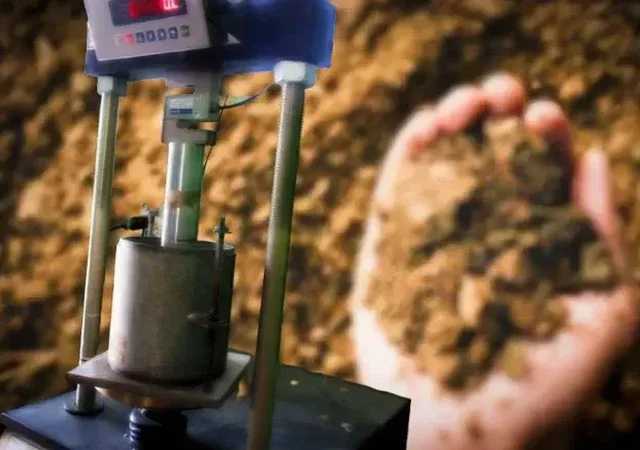
A 10-ton loading frame stands inside the North Vancouver lab. We use it daily for California Bearing Ratio tests. The dial gauges and proving ring are calibrated every quarter. A soil sample arrives from the field. First we run a Proctor. That gives us maximum dry density and optimum moisture. Then we compact material into a 6-inch mold at that exact moisture. Some clients only need the soaked CBR for subgrade. Others request unsoaked values for base course. The difference matters when you design pavement in Lynn Valley versus the Capilano Highlands. Rain patterns in North Vancouver push us toward the 96-hour soak. Water sits on subgrade here more days than not.
We see fine-grained glacial till with silt and clay. That material swells in the mold. We record swell percentage with a tripod and dial indicator before moving to the loading piston. Every specimen is prepared under ASTM D1883 and the current NBCC reference for pavement design. For projects where subgrade conditions vary widely, we recommend pairing this with in-situ density testing to verify field compaction matches the lab target values.

A soaked CBR sample from North Vancouver glacial till will often swell 2 to 5 percent before the piston even touches it. That swell is the first design parameter for subgrade treatment.

Process and scope

North Vancouver sits on the lower slopes of the Coast Mountains. Bedrock is shallow in many neighborhoods. Overburden is a mix of glacial advance and retreat deposits. That means our lab receives highly variable material. One day it is a clean sand from a Deep Cove excavation. The next day it is a silty clay from a Moodyville redevelopment. The CBR test works for both. We compact at optimum moisture determined by ASTM D698 or D1557. The specimen soaks for 96 hours under a surcharge weight equivalent to the anticipated pavement load. We read swell daily. After soaking we run penetration at 0.05 inches per minute. The proving ring records resistance. We calculate CBR at 0.1 inch and 0.2 inch penetration. The lower value usually governs.
Our reporting format includes moisture content before and after soak, dry density achieved, swell percentage, and the corrected CBR value. We also note the surcharge mass used. That matters for thin pavements on municipal roads in the District of North Vancouver. The lab maintains constant temperature during soaking. Water bath is within 2°C of room temperature. We follow the same protocol whether the sample comes from a new subdivision off Lonsdale or a commercial lot on Marine Drive.
Laboratory CBR Testing in North Vancouver: Soaked and Unsoaked Strength for Road Subgrades
Technical reference image — North Vancouver

Local considerations

North Vancouver gets over 1,700 millimeters of rain annually. That moisture drives the CBR down. A material that tests at 15 percent CBR at optimum moisture may drop below 5 percent after a wet winter. The soaked test simulates that worst case. We have seen projects where unsoaked CBR looked fine during summer construction but failed after the first October storm. The swell data is equally critical. A silty till from the Capilano River delta can swell 4 percent in the lab. That translates to heave under pavement. Cracks follow. The District of North Vancouver engineering department requires soaked CBR values on all new subdivision roads. They know their climate.
Frost is less of a concern here than moisture. But freeze-thaw cycles at higher elevations in the British Properties do affect subgrade. We recommend running CBR on samples taken at finished subgrade elevation, not from deeper excavation spoil. That top 300 mm controls pavement performance. Skipping the soak phase because the schedule is tight is a mistake. The lab result then overestimates field strength. Pavement thickness gets under-designed. The repair cost later dwarfs the testing cost now.

Need a geotechnical assessment?

Reply within 24h.

Email: info@geotechnicalengineering.vip

Technical data

ParameterTypical value
Standard methodASTM D1883-21
Mold diameter6 in (152.4 mm)
Compactive effortStandard or Modified Proctor
Soaking period96 hours submerged
Surcharge mass4.5 kg minimum
Penetration rate0.05 in/min
CBR reported at0.1 in and 0.2 in penetration
Swell measurementDial indicator on tripod, daily reads

Complementary services

01

Soaked and Unsoaked CBR Determination

Full ASTM D1883 procedure. Proctor compaction at optimum moisture. 96-hour soak with swell monitoring. Penetration test at 0.05 in/min. Report includes moisture, density, swell, and corrected CBR at 0.1 and 0.2 inches. We run the test on cohesive and granular materials from anywhere in North Vancouver.

02

Subgrade Evaluation Package

We combine Proctor, CBR, and a gradation curve from a washed sieve analysis. This package gives the pavement designer a complete picture of soil strength and drainage potential. Common for residential subdivisions in the District of North Vancouver where municipal standards require soaked CBR plus a grain-size report for subgrade acceptance.

Applicable standards

ASTM D1883-21: Standard Test Method for California Bearing Ratio (CBR) of Laboratory-Compacted Soils, ASTM D698-12(2021): Standard Test Methods for Laboratory Compaction Characteristics of Soil Using Standard Effort, ASTM D1557-12(2021): Standard Test Methods for Laboratory Compaction Characteristics of Soil Using Modified Effort, NBCC 2020: National Building Code of Canada, Part 4 structural design references for foundation and pavement systems

Frequently asked questions

What does a laboratory CBR test cost in North Vancouver?

A single CBR test including Proctor compaction, 96-hour soak, swell monitoring, and penetration runs between CA$190 and CA$250. The exact price depends on whether you need standard or modified Proctor effort and how many points we report. Volume pricing applies if you submit multiple samples from the same project.

How long does it take to get CBR results?

The minimum turnaround is 5 working days. The 96-hour soak alone takes 4 days. We compact the specimen on day one. Soaking runs from day one through day four. Penetration and reporting happen on day five. Rush service is not available because the soak time is fixed by ASTM D1883.

What is the difference between soaked and unsoaked CBR?

Soaked CBR measures strength after the soil has been saturated for 96 hours. It simulates a worst-case wet subgrade. Unsoaked CBR tests the material at the moisture content it arrived with, typically near optimum. The soaked value is lower and is what North Vancouver municipalities require for pavement design because of the region's heavy rainfall.

How much material do you need for one CBR test?

We need about 35 kg of representative soil. That lets us run a Proctor to find optimum moisture and maximum dry density, then compact the CBR specimen. For granular material with particles larger than 19 mm we may need more. Call us if the sample contains cobbles or rock fragments and we will advise on the replacement method.

What CBR value does the District of North Vancouver require for subgrade?

The District generally looks for a soaked CBR of at least 5 percent at 0.1 inch penetration for residential subgrade. Commercial arterials may require 10 percent or higher. If your material tests below 5 percent, stabilization with lime or cement is common practice. We can run CBR on treated samples to verify improvement before you place pavement.
Location and service area

We serve projects in North Vancouver and surrounding areas.

View larger map