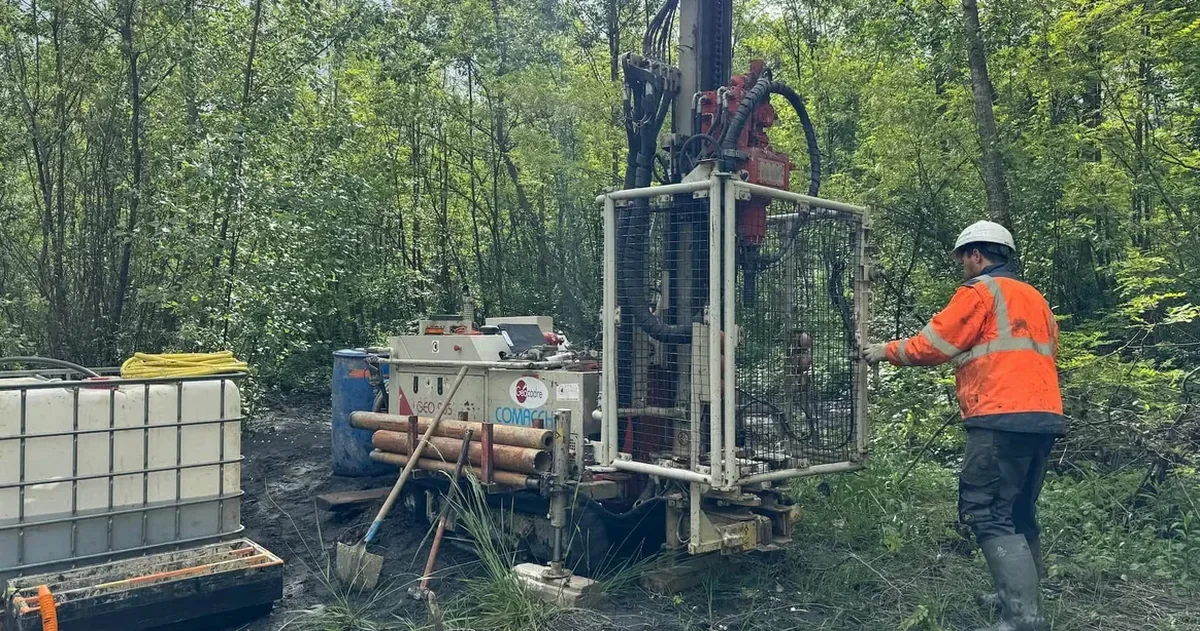
A triaxial cell under pressure, a direct shear box, and a consolidometer running overnight. That is what a real soil mechanics study looks like on the lab side. Out in North Vancouver, it starts with a split-spoon sampler or a Shelby tube pushed into glacial till or colluvium on a steep lot north of Highway 1. We correlate index properties from the Atterberg suite with strength envelopes from staged shearing, then deliver a single-page parameter sheet the structural engineer can drop straight into their model. No filler. Just numbers backed by repeatable lab curves and a borehole log tied to the site coordinates at 49.3206° N. For deep foundation work on the North Shore, the CPT test often complements our lab program by providing continuous tip resistance and sleeve friction before we even open a tube.
A single oedometer curve on an undisturbed sample tells you more about settlement risk than a hundred SPT blows in glacial silt.
Process and scope
The most common error we see on North Vancouver projects is treating all glacial deposits as competent bearing material without checking for overconsolidation rebound or silt seams. A contractor hits what looks like hardpan at 2 m, assumes 300 kPa bearing, and pours footings without a mechanics study. Six months later, a wet winter saturates a thin silt lens, excess pore pressure builds, and the settlement curve bends the wrong way. We run incremental loading oedometer tests to nail down the preconsolidation stress and constrained modulus. If the natural water content is above the plastic limit, we flag it immediately. On steeper sites near the Capilano escarpment, we also run drained direct shear on undisturbed samples to verify the friction angle used in slope models before excavation begins.
Quick answers
What is the typical budget range for a soil mechanics study on a single-family lot in North Vancouver?
For a standard single-family lot on the North Shore, a soil mechanics study including drilling, undisturbed sampling, Atterberg limits, consolidation, and triaxial shear typically runs between CA$3,680 and CA$6,580 depending on access, depth, and number of samples. Sites requiring cyclic liquefaction screening or deeper bedrock probing will fall toward the upper end.
How long does a full soil mechanics study take from drilling to final report for a North Vancouver project?
Drilling and sampling usually take one day. Consolidation tests require 3 to 5 days due to incremental loading cycles. Triaxial shear adds another 3 to 4 days for specimen preparation, saturation, and shearing. The final interpretive report is typically delivered within 10 to 12 business days after field work, faster if preliminary parameters are needed for an imminent foundation pour.
Do you need to test every borehole sample, or can you select representative specimens to reduce cost?
We select representative specimens from each distinct stratigraphic unit encountered in the borehole. There is no value in testing every meter if the material is homogeneous. Our approach focuses on key layers: the proposed bearing stratum, any soft or compressible horizons, and the deepest material that will feel the stress bulb. This keeps the lab program lean while still satisfying NBCC 2020 requirements for foundation design.