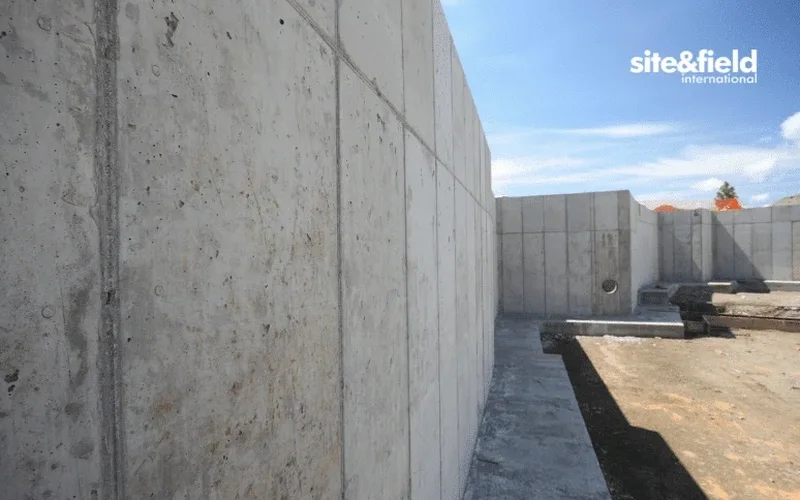
North Vancouver sits at the base of the Coast Mountains, where steep slopes and deep glacial till deposits define nearly every building site. Designing a retaining wall here isn't just about holding back soil; it's about managing the relentless rainfall that saturates the ground from October to April and the seismic demands of a city that sits within the most active earthquake zone in Canada. When a contractor breaks ground on a Lonsdale slope or a Lynn Valley property, the wall must account for hydrostatic pressure that builds behind the wall during winter storms. We approach each retaining wall design by first mapping the subsurface stratigraphy—often a mix of till, sand lenses, and colluvium—to determine the real lateral earth pressures, not just textbook values. This local soil behavior, combined with the National Building Code of Canada (NBCC) seismic provisions, shapes every reinforcement and drainage detail we specify.
In North Vancouver, a retaining wall fails not because the steel yields, but because water finds the one path the designer didn't anticipate.
Regional considerations
The excavator bucket scrapes along the cut face, and within minutes, water starts seeping from a sand lens nobody saw on the borehole logs. That's the North Vancouver reality—glacial deposition was chaotic, and isolated pockets of saturated sand can trigger a local failure before the wall reinforcement is even placed. A retaining wall design that ignores these perched water tables is a schedule and budget risk waiting to happen. We see it most often on east-facing slopes below the Cut, where groundwater migrates along till-bedrock interfaces. Our design process includes a risk matrix that maps out these construction-phase hazards: sloughing during excavation, base heave in soft silt, and global instability if temporary cuts are left unsupported too long. The cost of a wall rebuild after a winter storm can exceed three times the original design fee, so we treat the geotechnical investigation not as a line item but as an insurance policy for the structure's service life.
Quick answers
What type of retaining wall works best on North Vancouver's steep lots?
It depends entirely on the cut height and the soil profile. For walls under 1.5 m with good granular backfill, a gravity wall or reinforced cantilever often works. For walls over 3 m, especially where we encounter silt till or a rising groundwater table, we lean toward tied-back soldier piles or mechanically stabilized earth. The key is matching the wall type to the real lateral earth pressures and the available bearing stratum, not picking a system and forcing the ground to fit.
How do you handle drainage behind a retaining wall in such a rainy climate?
North Vancouver's annual rainfall exceeds most Canadian cities, so we design drainage to handle sustained saturation. Our standard detail includes a continuous prefabricated drain board against the back of the wall, a 150 mm perforated collection pipe at the base, and free-draining backfill with less than 5% fines. The pipe outlets at grade or connects to the storm system. We also specify filter fabric to prevent fines from clogging the drain system over the decades.
Do I need a building permit for a retaining wall in North Vancouver?
Yes, the District of North Vancouver requires a building permit for retaining walls over 1.2 m in height or walls supporting a surcharge like a driveway or building. Our stamped engineering drawings meet the permit submission requirements, and we coordinate with the municipality's plan review process.
What is the typical cost range for retaining wall engineering in North Vancouver?
For a typical residential retaining wall project in North Vancouver, the engineering design fee ranges from CA$1,220 for a straightforward gravity wall to CA$5,180 for a complex tied-back or MSE wall with full geotechnical investigation and stamped drawings. The exact cost depends on wall height, site access, and the required investigation depth.