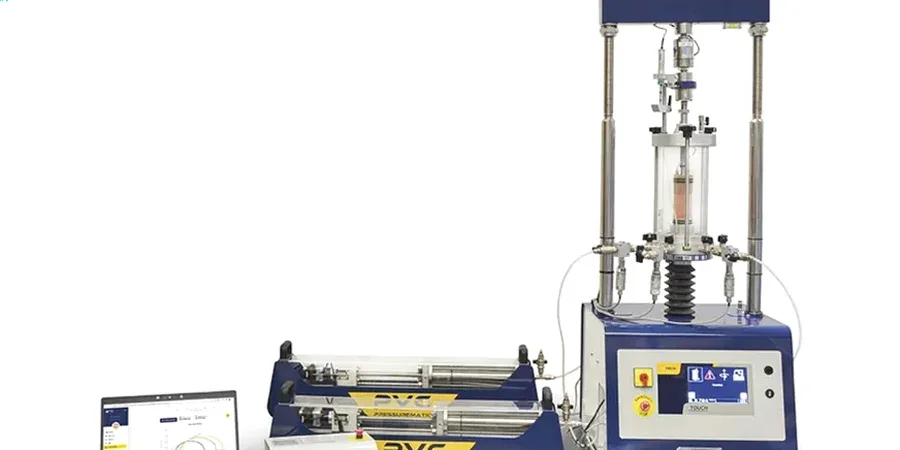
Foundation design in North Vancouver demands a precise understanding of soil behavior under load, which is why the triaxial test is specified in the National Building Code of Canada (NBCC) for projects on the District's characteristic glacial till and marine clay deposits. Unlike simpler index tests, the triaxial test simulates the actual in-situ stress conditions that a soil element will background beneath a mat foundation or deep excavation shoring system. Our laboratory processes undisturbed Shelby tube samples recovered from sites across the North Shore, subjecting them to multi-stage loading sequences that generate the Mohr-Coulomb failure envelope—critical for modeling slope stability in the Argyle and Lynn Valley corridors. When site conditions demand verification of bearing capacity on steeply inclined parcels, we complement the strength profiling with a site-specific SPT investigation to correlate our advanced lab results with field penetration resistance values obtained directly in the North Vancouver formation.
A properly executed triaxial test on an undisturbed North Vancouver soil sample reveals the effective cohesion and friction angle that index tests alone cannot provide, directly reducing the uncertainty in your geotechnical model.
Quick answers
How much does a triaxial test cost in North Vancouver?
A standard single-stage triaxial test on an undisturbed sample in our North Vancouver lab ranges from CA$2,320 to CA$3,730, depending on whether you require a UU, CU with pore pressure measurement, or CD configuration. A full three-stage multi-stage test for a complete Mohr-Coulomb envelope typically falls at the upper end of that range. The final cost reflects the confining pressure increments, strain rate selection, and the interpretive reporting package your engineer requires for NBCC compliance.
What soil types in North Vancouver require a triaxial test instead of direct shear?
Any cohesive soil that will be loaded under undrained conditions—such as the marine silty clays found in the Lower Lonsdale and Harbourside areas—requires a triaxial test because the direct shear box cannot prevent drainage or measure pore pressure. The triaxial test is also mandatory for cyclic liquefaction assessment in the sandy layers that underlie North Vancouver’s river deltas, where you need to track excess pore pressure generation under repeated loading, something only a triaxial cell can quantify accurately.
How long does it take to get triaxial test results?
A consolidated undrained triaxial test typically requires 10 to 14 business days from sample receipt to final report delivery. This timeline includes back-pressure saturation (24–48 hours), consolidation to the target effective stress (24–72 hours, depending on soil permeability), the shearing stage at a controlled strain rate, and the engineering interpretation phase where we plot stress paths and derive c’, φ’, and stiffness parameters. Drained tests on coarse soils take longer because the shear rate must be slow enough to maintain zero excess pore pressure throughout the test.
Do you provide the effective stress parameters my structural engineer needs for retaining wall design?
Yes. For every CU triaxial test, we report the effective cohesion (c’) and effective friction angle (φ’) derived from Mohr circles plotted at maximum deviator stress or at a specified strain criterion, whichever your project geotechnical engineer specifies. We also supply the Skempton pore pressure coefficient at failure (Af), the undrained shear strength (c_u), and the secant Young’s modulus at 50% of peak stress (E_50), all of which feed directly into the load and resistance factor design (LRFD) calculations required by the NBCC for cantilever and gravity retaining walls in North Vancouver.
What sample quality do you need for a reliable triaxial test?
We require undisturbed samples recovered in thin-walled Shelby tubes (ASTM D1587) with an area recovery ratio above 90% and no visible signs of disturbance such as cracking, swelling, or gravel inclusions that would compromise the membrane during confining pressure application. Samples must be sealed with wax immediately after extrusion in the field and transported in cushioned containers to our North Vancouver facility within 48 hours. If your site investigation program includes CPT soundings that indicate potentially sensitive or structured soils, we recommend a modified sampling protocol to preserve the natural fabric of the deposit before triaxial testing begins.