← Home · Foundations

Raft & Mat Foundation Design in North Vancouver

Together, we solve the challenges of tomorrow.

LEARN MORE →

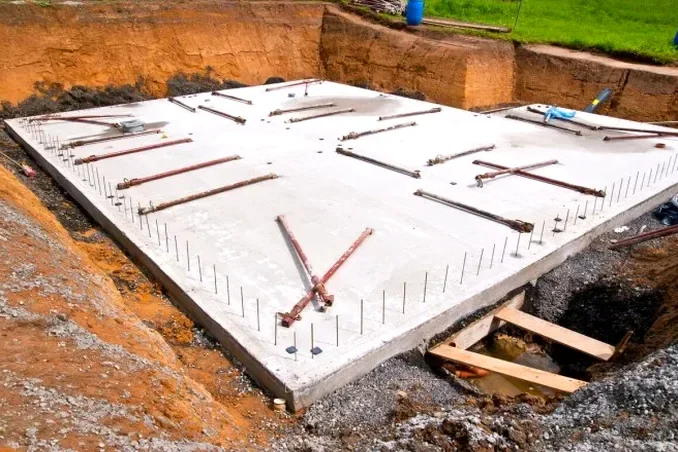
North Vancouver sits on a landscape shaped by the last glaciation, with till, glaciomarine silts, and colluvium draped across slopes averaging 15 to 30 percent. These conditions, combined with a 2021 population of over 58,000, demand foundation systems that can handle both differential settlement and lateral spread risk. A raft or mat foundation distributes structural loads across a continuous slab, reducing point pressures on variable subsoil, which is critical where bedrock depth can change by several metres within a single property. The approach follows the National Building Code of Canada (NBCC 2020) and CSA A23.3 for concrete design, ensuring every mat foundation accounts for the specific stratigraphy encountered on the North Shore. When site investigation reveals lenses of soft silt beneath the till, we often integrate findings from an in-situ permeability test to confirm drainage capacity before finalizing slab thickness and reinforcement.

A well-designed raft foundation on North Vancouver till can limit total settlement to under 25 mm, even with variable subgrade stiffness across the footprint.

Process and scope

A recent project off Lonsdale Avenue involved a four-storey mixed-use structure where boreholes revealed a loose saturated silt layer at 4 metres, overlying dense till. The design team increased the raft thickness to 600 mm and added edge beams to bridge the weak zone, preventing angular distortion beyond the 1/500 limit specified for masonry infill. Key phases of a mat foundation design include laser-leveled excavation, a mud slab or lean concrete seal, waterproofing where required by local groundwater, and two-way reinforced concrete with bar schedules verified against finite element analysis. Soil-structure interaction modeling runs multiple load combinations to map bending moments and shear, particularly near column clusters. In North Vancouver's rain-heavy climate, sub-slab drainage is non-negotiable, and a plate load test on the compacted subgrade provides direct modulus of subgrade reaction values before the first rebar is placed.
Raft & Mat Foundation Design in North Vancouver
Technical reference image — North Vancouver

Local considerations

The District of North Vancouver experienced rapid hillside development during the 1960s and 1970s, often on cut-and-fill terraces that were compacted to standards far below today's requirements. A mat foundation placed over uncontrolled fill can tilt or crack if the fill consolidates unevenly under sustained load. The other persistent risk is perched groundwater, which accumulates above the till during the October-to-March wet season and can soften the upper subgrade or cause buoyancy issues if not intercepted by perimeter drains. Omitting a thorough site investigation before designing a raft or mat foundation invites long-term differential settlement that is difficult to remediate once the superstructure is up. A rigorous geotechnical program, including boreholes spaced no more than 15 metres apart, is the only way to map fill thickness and water table fluctuations accurately enough for a reliable mat foundation design on the North Shore.

Need a geotechnical assessment?

Reply within 24h.

Email: info@geotechnicalengineering.vip

Technical data

ParameterTypical value
Typical slab thickness range400 mm – 1,200 mm
Maximum allowable bearing pressure (dense till)300 – 500 kPa (factored)
Subgrade reaction modulus (ks) range20 – 60 MN/m³
Concrete strength classCSA A23.3 Class C-2 (30 MPa min)
Reinforcement grade400R or 500R welded wire mesh / rebar
Angular distortion limit (masonry)1/500 (NBCC serviceability)
Seismic design category (North Vancouver)D (NBCC 2020, Site Class C/D/E)

Complementary services

01

Geotechnical investigation for mat foundations

Boreholes and test pits to map till, silt, and fill thickness across the building footprint, with laboratory classification and shear strength testing.

02

Subgrade modulus determination

Plate load tests and correlations with SPT N-values to derive ks values for soil-structure interaction modeling under raft foundations.

03

Structural design of reinforced concrete raft

Finite element analysis of the mat slab including column punching shear checks, edge beam detailing, and reinforcement scheduling per CSA A23.3.

04

Construction-phase monitoring

Compaction testing of subgrade and granular base, rebar inspection, concrete slump and cylinder testing, and post-pour settlement survey.

Applicable standards

NBCC 2020 (National Building Code of Canada) – Division B, Part 4, CSA A23.3:19 – Design of Concrete Structures, CSA A23.1:19/A23.2:19 – Concrete Materials and Methods of Test Construction, ASTM D1194 / D1195 – Plate Load Test (where referenced for ks), ASTM D2487 – Unified Soil Classification System

Frequently asked questions

What is the typical cost range for a mat foundation design in North Vancouver?

For a single-family or small multi-unit project, the geotechnical investigation and structural design package typically falls between CA$1,330 and CA$6,090, depending on the number of boreholes, the complexity of the soil profile, and the structural scope. Larger commercial projects exceed this range.

How does North Vancouver's seismic hazard affect mat foundation design?

The NBCC 2020 places North Vancouver in a high seismic zone. Mat foundations must be designed for the Site Class determined from shear wave velocity data. On soft clay or loose silt sites (Site Class D or E), the spectral acceleration values increase, and the raft may need to be stiffened with deeper edge beams or combined with ground improvement to control total and differential settlement during the design earthquake.

Can a mat foundation be used on sloped lots in North Vancouver?

Yes, but it requires a stepped or sloped raft configuration with careful subgrade preparation. The cut portion of the site often exposes dense till, while the fill side may be looser. The design must include a transition detail between the two bearing conditions and a sub-slab drainage system to prevent water accumulation behind the up-slope edge of the raft.
Location and service area

We serve projects in North Vancouver and surrounding areas.

View larger map