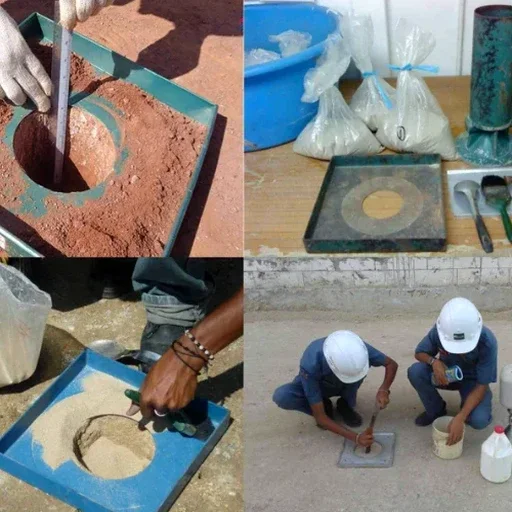
Compaction control on the North Shore isn't a checkbox exercise; it's what separates a stable foundation from one that settles into the underlying glacial till and colluvium that covers much of North Vancouver. The sand cone density test, run per ASTM D1556, gives us a direct field measurement of in-place density on compacted fill, road base, and utility trench backfill. With average annual rainfall exceeding 1,500 millimetres on the slopes of the North Shore, moisture conditioning during compaction becomes a decisive factor, and verifying the result means going beyond the proctor curve in the lab. In our background, projects between Lynn Creek and the Capilano River demand a tight feedback loop between the field crew and the geotechnical engineer, and the sand cone density method remains the practical go-to when nuclear gauges are impractical or the site access limits heavier equipment. For deeper subgrade characterization under flexible pavements, we often pair it with a CBR test to tie density to strength before the asphalt goes down.
In North Vancouver's wet-weather construction windows, the sand cone test is often the most reliable field density method when nuclear gauges are shut down by moisture and regulatory constraints.
Process and scope
What we see repeatedly in North Vancouver is that density problems trace back to the fill material itself, not just the roller passes. The native glacial till here can carry fines that are sensitive to over-compaction on the wet side of optimum, and once you trap excess pore pressure, no amount of additional rolling fixes it. A proper sand cone test forces you to excavate a small, clean hole, capture all the removed material, and weigh it against the calibrated sand volume, which means the technician's technique at the bottom of a trench in Lynn Valley matters as much as the lab's proctor number. We calibrate our sand and cones through our ISO 17025-accredited lab, and because the method measures total density, we always run a companion moisture content from the excavated soil to back-calculate dry density. On sites where fill lifts exceed 300 mm, or where crushed base overlies softer native clay, we may recommend supplementing the sand cone program with a
plate load test to confirm the modulus of the compacted layer under actual bearing pressure. And when the grain size distribution of the borrow material is in question, a quick
grain size analysis helps confirm whether the spec sand cone target density is even achievable with the material on site.
Standards that apply
ASTM D1556 / D1556M - Standard Test Method for Density and Unit Weight of Soil in Place by the Sand-Cone Method, NBCC 2020 - National Building Code of Canada, Division B, Geotechnical provisions for fill compaction, CSA A23.3 - Design of Concrete Structures (references to subgrade preparation and compaction requirements), CSA S501 - Moderating the effects of permafrost degradation (referenced for thermal effects on density in cold climates), ASTM D698 / D1557 - Standard Proctor / Modified Proctor compaction tests (lab reference for field density acceptance)
Quick answers
What does a sand cone field density test cost in North Vancouver?
A single sand cone density test in North Vancouver typically runs between CA$150 and CA$170 per point, assuming reasonable site access and standard depths. The rate covers the technician's time, the calibrated sand and cone apparatus, companion moisture determination, and the signed field report with percent compaction. Larger programs with multiple test locations per visit usually bring the per-test cost down because mobilization gets spread across more points. We supply a firm quote once we understand the lift thickness, number of locations, and whether the work is during regular hours or requires night shifts for active roadways.
When is the sand cone method preferred over a nuclear density gauge on the North Shore?
We lean on the sand cone when the fill contains significant coarse gravel or cobbles that skew a nuclear gauge reading, when the site is in a residential neighbourhood where radiation licensing is a hassle, or when we are testing trench backfill in a deep, narrow excavation where the gauge's source-detector geometry won't fit properly. The North Shore's wet winters also complicate nuclear gauge calibration because surface moisture throws off the hydrogen-based density inference, making the physical sand cone more dependable.
How long does a sand cone density test take on site?
For an experienced two-person crew, a single sand cone test point takes about 15 to 20 minutes from setting up the base plate to bagging the excavated soil for moisture determination. Drilling the small hole through a well-compacted crushed base can add a few minutes. On a typical North Vancouver compaction QA program, we can complete six to eight points in a half-day visit, including moving between lifts and recording layer thicknesses.
What percent compaction is required for residential footings in North Vancouver?
Most North Vancouver building permits reference 95% of modified Proctor maximum dry density (ASTM D1557) for structural fill directly beneath footings and slabs-on-grade. Utility trench backfill is often specified at 92% to 95% modified, depending on the pipe material and the municipality's engineering standards. For landscape fills and non-structural pads, 90% standard Proctor may be accepted. We always confirm the spec against the project's geotechnical report and the District of North Vancouver's current requirements.