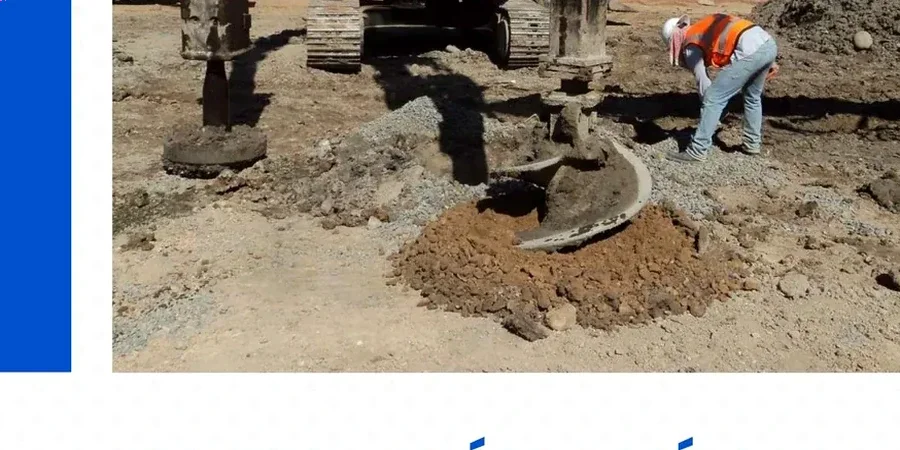
The transformation of North Vancouver from scattered mills on the foreshore to a dense urban center pressed against the Coast Mountains has always been a negotiation with challenging ground. Early loggers and shipbuilders worked around the deep, soft deposits of the Capilano and Seymour river deltas; today’s engineers must design foundations that perform reliably on those same compressible silts and loose sands. In our background, stone column design offers a practical ground improvement path across much of the North Shore, provided the solution is tuned to the local stratigraphy. We routinely tie our layouts to data from CPT testing to map the thickness of soft zones and from SPT drilling where gravelly interbeds make cone refusal a concern. The result is a stone column grid that reduces settlement and improves bearing capacity without the cost and carbon footprint of deep piled foundations.
A well-designed stone column grid in North Vancouver’s marine silts can double the allowable bearing pressure while cutting post-construction settlement by more than half.
Regional considerations
The contrast between a site near Marine Drive in the Pemberton Heights area and one down on the Dollarton flats could hardly be starker. Up on the slopes, glacial till is shallow and stiff, and stone column design may be unnecessary—conventional spread footings often suffice. Down on the floodplain, however, thick post-glacial silts and loose sands create the very conditions that make ground improvement indispensable. The biggest misstep we encounter is a one-size-fits-all grid that ignores lateral variability: a column that terminates prematurely in a soft lens can leave a weak zone that concentrates differential settlement under seismic loading. Equally risky is underestimating the influence of nearby buried creek channels; these paleo-channels, common between the Capilano and Seymour rivers, can carry organics that degrade column confinement. We mitigate this by running settlement analyses under both static and post-earthquake excess pore-pressure scenarios and adjusting the column spacing and length block by block rather than applying a uniform layout.
Quick answers
What do stone column design services cost for a typical North Vancouver residential lot?
For a standard single-family or duplex lot on the North Shore, stone column design—covering geotechnical analysis, column layout, and installation specifications—typically runs between CA$1,790 and CA$6,880. The range depends on the number of boreholes or CPT soundings reviewed, the complexity of the soil profile, and whether seismic liquefaction assessment is required. Commercial and multi-family projects with larger treatment areas fall toward the upper end due to the added modeling effort.
How do you confirm that stone columns actually perform as designed in North Vancouver soils?
We specify post-installation verification that usually includes a combination of modulus tests (plate load or zone load tests on individual columns) and cone penetration tests between columns to check that the composite ground has reached the design tip resistance. On critical jobs we also run pre- and post-treatment shear-wave velocity profiles to confirm that the improvement ratio used in the settlement analysis is being met in the field.
Are stone columns viable on steeply sloping sites in North Vancouver?
On slopes steeper than about 15 degrees, stone columns alone rarely solve the problem because lateral confinement drops off and the columns can lose integrity near the face. We typically combine a reduced stone column grid with a retaining wall or a tied-back system to stabilize the overall mass. In these cases the columns handle settlement under the building footprint while the structural wall addresses global slope stability.