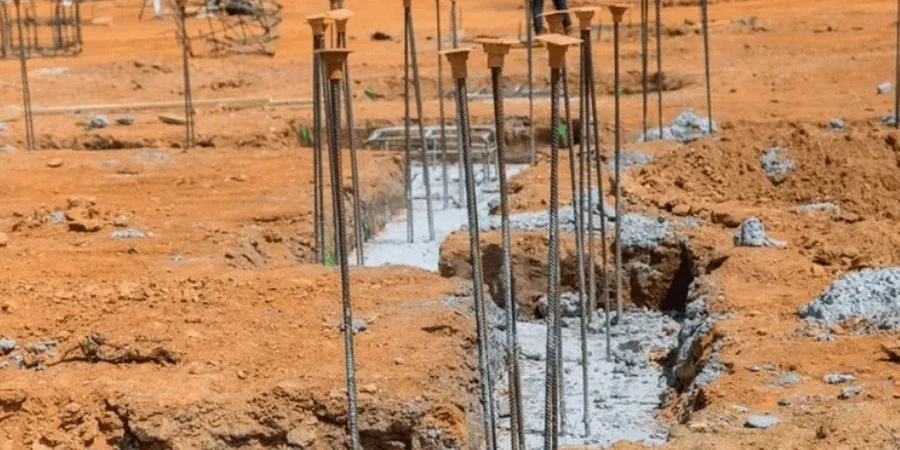
North Vancouver sits on some of the most challenging terrain in the Lower Mainland. We have seen projects where the soil profile changes completely within 50 meters — competent till on one end of the lot, compressible marine clay on the other. That kind of variability is why pile foundation design here demands more than a textbook approach. Our team has spent years correlating borehole data across the District and City, from the Lynn Valley corridor down to the waterfront near Lonsdale. We understand how the advance of glacial ice shaped the subsurface, leaving behind a mix of ablation till, glaciomarine silts, and occasional buried organic layers. When you are placing a deep foundation in North Vancouver, the difference between a straightforward driven pile and a costly drilled shaft often comes down to interpreting that geological history correctly. We routinely pair our pile foundation design with an SPT drilling program to confirm refusal depths and skin friction parameters before a single pile goes in the ground.
In North Vancouver, the distance from loose silt to dense till is sometimes less than two metres — knowing exactly where that transition happens is what separates a reliable pile design from an expensive guess.
Regional considerations
A 2023 study by the Geological Survey of Canada confirmed that an active crustal fault runs beneath the North Shore mountains, capable of generating a magnitude 6.5 event close to the surface. In North Vancouver, where population density now exceeds 4,900 people per square kilometre, a seismic event that triggers soil settlement or slope movement would have severe consequences for any structure not properly founded. We have reviewed pile designs on Keith Road where the original concept called for end-bearing piles terminating just above the till — a detail that might have worked under static conditions but would have failed during liquefaction-induced settlement of the overlying silt. Our pile foundation design process includes a serviceability limit state check that models the full soil column response to the 1 in 2,475 year earthquake specified in NBCC. If the analysis shows more than 25 mm of differential settlement between adjacent piles, we adjust the pile length or group configuration until the structure meets the performance criteria expected for post-disaster buildings.
Standards that apply
NBCC 2020 — National Building Code of Canada, seismic provisions for deep foundations, CSA S6:19 — Canadian Highway Bridge Design Code, Section 6: Foundations, CSA A23.3 — Design of Concrete Structures, provisions for drilled shafts, ASTM D1143 — Standard Test Methods for Deep Foundation Elements Under Static Axial Compressive Load, ASTM D3689 — Standard Test Methods for Deep Foundation Elements Under Static Axial Tensile Load, BC Building Code 2018 — provincial amendments to NBCC relevant to the North Shore region
Quick answers
What is the typical cost range for a pile foundation design package in North Vancouver?
For a typical single-family residential lot on the North Shore, the combined geotechnical investigation and pile foundation design package generally falls between CA$2,540 and CA$8,240. The range depends on access conditions — steep lots in areas like Blueridge or Lynnmour may require a smaller rig and more setup time — and on the number of boreholes needed to satisfy the District of North Vancouver's building permit requirements. A commercial or multi-family project will be at the upper end or beyond, especially if dynamic pile testing is specified.
How deep do piles typically need to go in North Vancouver?
Depth to competent glacial till varies considerably across the municipality. In the lower Lonsdale area and parts of the waterfront, we often encounter till between 8 and 12 metres below grade. Further up the mountain, in neighbourhoods like Edgemont Village or the upper Capilano Highlands, overburden can exceed 20 metres, and we have driven piles to 28 metres before reaching refusal on dense till. The only way to know for your specific lot is to drill and measure refusal depth directly.
Do you design both driven piles and drilled shafts?
Yes, we work with both systems and the choice comes down to site conditions. Driven steel H-piles are common in North Vancouver because they install quickly and mobilize high end-bearing on till. But where vibration during driving would risk damaging adjacent structures — say, a heritage home on a narrow lot — we specify drilled cast-in-place shafts instead. The design methodology changes with the installation method, particularly for skin friction estimation, and we address that early in the process.
What seismic provisions does the pile design include?
Our designs follow the seismic requirements of NBCC 2020 for Site Classes D and E, which cover most of North Vancouver. We evaluate liquefaction potential using the Seed and Idriss simplified procedure, calibrated against local SPT data, and we model the pile group under lateral spreading loads if the site sits within 50 metres of a free face or channel bank — a common situation along Mosquito Creek and the Capilano River corridors. The pile-to-cap connection is detailed to develop the full plastic moment of the pile under seismic demand.