← Home · Geophysics

Seismic Tomography (Refraction / Reflection) for Site Characterization in North Vancouver

Together, we solve the challenges of tomorrow.

LEARN MORE →

A six-storey mixed-use project on Lonsdale Avenue hit a surprise last fall. The boreholes said till, but excavation revealed a buried channel with soft silt right under the southeast corner. They had to stop work for two weeks. That is exactly the kind of problem a tomographic survey catches before shovels go in. We run seismic refraction and reflection lines across North Vancouver sites to map velocity contrasts in the subsurface—bedrock depth, fracture zones, loose saturated layers. For deeper targets or where traffic noise limits refraction, we switch to reflection acquisition. The output is a continuous P-wave velocity profile, not just points. On a recent Marine Drive job near the mouth of Mackay Creek, the seismic refraction profile picked up a low-velocity lens at 8 m depth that coring alone had missed. We often pair the velocity model with a MASW survey to add shear-wave data for seismic site class, especially where the NBCC 2020 requires Class C or better for essential facilities.

A single seismic line can replace three or four boreholes for bedrock mapping—faster, less invasive, and a continuous profile instead of point data.

Process and scope

North Vancouver’s subsurface is a glacial legacy—Vashon till over Capilano sediments over bedrock, but the sequence is rarely clean. The city sits on the slopes of the Coast Mountains, with bedrock outcrops at Upper Levels Highway and deep sediment fill down toward the Burrard Inlet waterfront. Velocity contrasts can be sharp: till at 1500–2000 m/s, saturated sand at 800–1200 m/s. We use 24- or 48-channel seismographs with geophone spacing as tight as 2 m for high-resolution shallow targets. Where the water table is shallow—common below Keith Road—refraction first-break picking gets tricky; we run reflection profiling to image below the saturated zone. Data processing follows ASTM D5777 for refraction and ASTM D7128 for reflection, with tomographic inversion in Geogiga or SeisImager. The deliverables include a 2D velocity cross-section with interpreted lithology boundaries, depth to bedrock in meters, and a rippability classification if needed for excavation planning. For deep foundation design, the velocity model feeds directly into footings and mat foundations analysis, giving the structural engineer a continuous ground model rather than interpolating between boreholes.
Seismic Tomography (Refraction / Reflection) for Site Characterization in North Vancouver
Technical reference image — North Vancouver

Local considerations

The difference between a site up near Lynn Valley and one down by the shipyards is night and day. Up high you have thin till over granodiorite—refraction picks bedrock in three shots. Down at water level you can have 30 meters of compressible marine silt and organic layers that swallow seismic energy. Clients sometimes assume one method fits the whole city. It does not. We have seen refraction fail completely on a saturated fill site in the Lower Lonsdale flats because the low-velocity layer masked everything below. We switched to CPT testing for that job to get a direct tip resistance log through the soft zone. The real risk is designing foundations on an incomplete ground model—you get pile lengths that are too short, or you miss a buried channel that will cause differential settlement later. Tomography gives you a two-dimensional view, but interpreting it requires someone who knows North Shore geology. Not just picking first arrivals, but knowing that a 1200 m/s layer with a reverse velocity gradient in this part of the city probably means loose saturated sand, not weathered rock.

Need a geotechnical assessment?

Reply within 24h.

Email: info@geotechnicalengineering.vip

Technical data

ParameterTypical value
MethodSeismic refraction and reflection (P-wave)
Depth Range5–100 m (refraction), 10–300 m (reflection)
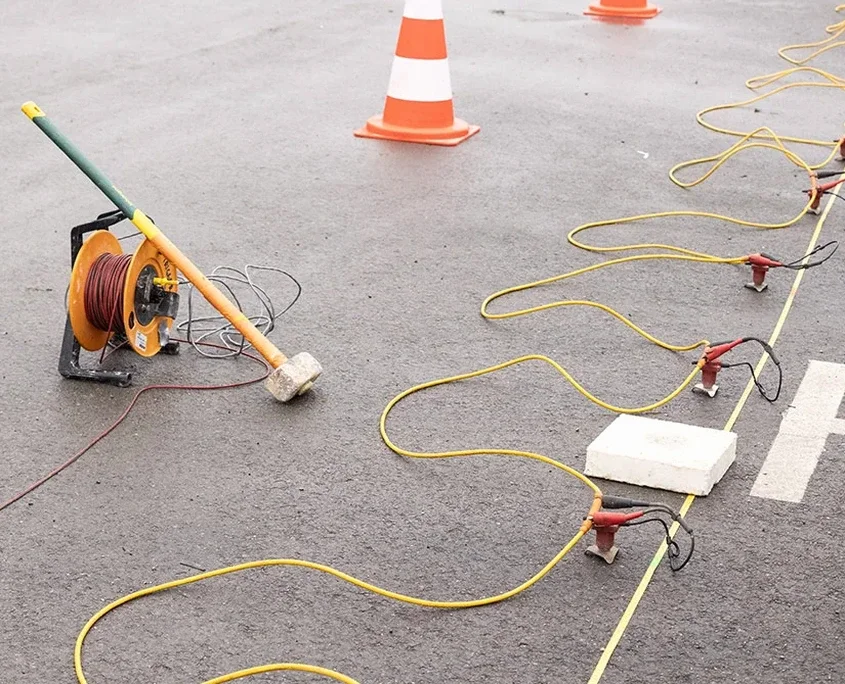
Geophone Spacing2–5 m for high-resolution shallow surveys
Channel Count24 or 48 channel seismograph
Energy SourceSledgehammer (shallow) or accelerated weight drop (deeper)
Standard ReferenceASTM D5777 (refraction), ASTM D7128 (reflection), NBCC 2020
Key Output2D P-wave velocity cross-section, depth-to-bedrock, rippability log

Complementary services

01

Depth-to-Bedrock and Rippability Surveys

Refraction profiling for excavation planning and foundation design. We map the till-bedrock interface across the site, classify rock rippability by seismic velocity, and deliver a continuous cross-section for the structural engineer. Typical on sloping lots above Highway 1 where bedrock depth varies sharply.

02

Seismic Reflection for Deep Stratigraphy

When the water table is near surface or bedrock is deeper than 30 meters, we deploy reflection acquisition with CMP stacking. This gives us stratigraphic resolution down to 200–300 meters for deep foundation or tunnel feasibility work, particularly useful along the Burrard Inlet corridor.

03

Combined Refraction + MASW for Seismic Site Class

Paired P-wave refraction and surface-wave MASW on the same spread. We extract Vs30 and derive the NBCC seismic site class from shear-wave velocity. Required for essential facilities and increasingly requested for mid-rise residential under current North Vancouver building permit conditions.

Applicable standards

NBCC 2020 – National Building Code of Canada, seismic provisions, CSA A23.3 – Design of concrete structures, foundation references, ASTM D5777 – Standard Guide for Seismic Refraction, ASTM D7128 – Standard Guide for Seismic Reflection, BC Building Code 2024 – provincial adaptation with North Shore geotechnical notes

Frequently asked questions

What does a seismic tomography survey cost in North Vancouver?

Budget between CA$3,390 and CA$7,930 depending on line length, depth target, and whether you need refraction alone or combined refraction and reflection. A short refraction line for a single-family lot starts at the lower end. Multi-line surveys with reflection processing and MASW for site class push toward the upper range. We provide a fixed-price quote after reviewing the site plan and geotechnical brief.

How long does a seismic survey take on site?

A single refraction line of 69 meters takes about two to three hours on site with a two-person crew. Longer lines or reflection spreads with multiple shot points can take a full day. Data processing and interpretation add another three to five business days before you get the final report.

Can you do seismic tomography on a small residential lot?

Yes, we run short refraction spreads on lots as narrow as 15 meters. The key is having enough line length for the target depth—rule of thumb is four to five times the depth you want to image. For a typical North Vancouver single-family lot we usually reach 15–20 meters depth, which covers most foundation concerns.

What is the difference between refraction and reflection tomography?

Refraction uses first-arrival travel times and works best when velocity increases with depth—ideal for bedrock mapping where till overlies faster rock. Reflection uses reflected energy from acoustic impedance contrasts and works even when a low-velocity layer sits below a faster one. In North Vancouver, we use refraction for shallow bedrock and reflection for deep or complex stratigraphy where the water table creates a velocity inversion.

Do I still need boreholes if I have a seismic survey?

Seismic gives you a continuous velocity profile but does not tell you soil type directly—you need at least one borehole or test pit to calibrate the velocity layers to actual lithology. We typically recommend one borehole per seismic line for ground-truthing. The combination gives you the best of both: continuous coverage from geophysics plus material samples from drilling.
Location and service area

We serve projects in North Vancouver and surrounding areas.

View larger map